This article was originally published by the Family Firm Institute (FFI) in their FFI Practitioner Weekly editions on June 4th and June 11th, 2025. We are grateful to them for publishing it and are proud to be able to share it as a Hidden Gem.

by James E. Hughes, Jr. and Keith Whitaker (2025) | Summary :
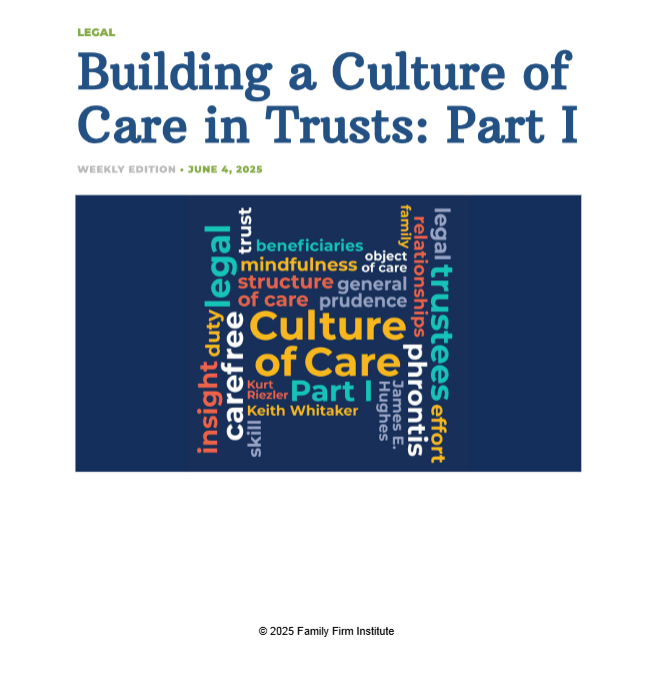
In Building a Culture of Care in Trusts: Part 1, James E. Hughes, Jr. and Keith Whitaker explore the concept of establishing a “culture of care” in the management of trusts. The authors argue that a trustee’s duty is not just about managing financial assets but also about nurturing the beneficiaries’ well-being. They challenge the traditional, purely financial view of trust management by introducing a broader perspective that includes emotional and relational care.
The article discusses how a “culture of care” can be defined and implemented within the context of trusts. For the authors, care is not a mere duty but a proactive approach that focuses on mindfulness, compassion, and attention to the beneficiaries’ needs. They draw from the work of philosopher Kurt Riezler, whose ideas on the structure of care—phronesis (thoughtfulness), epimeleia (applied effort), and merimna (worry or care)—serve as the foundation for building this culture.
The authors suggest that trustees must first and foremost be attentive to the human aspect of their role. The “care” they provide is not only about distributing assets but about fostering a sense of security, belonging, and fulfillment in beneficiaries’ lives. This approach goes beyond legal obligations and focuses on enhancing the beneficiaries’ quality of life, thus fulfilling the true purpose of a trust: to serve the beneficiaries in a holistic manner.
In conclusion, the article advocates for a shift in trustee practice, urging fiduciaries to incorporate care into their management style, making it a central aspect of their responsibility. The culture of care approach suggests that by attending to emotional and relational dynamics, trustees can better fulfill their duties and ensure that trusts benefit the beneficiaries in meaningful, lasting ways.
This article was originally published by the Family Firm Institute (FFI) in their FFI Practitioner Weekly editions on June 4th and June 11th, 2025. We are grateful to them for publishing it and are proud to be able to share it as a Hidden Gem.
View the full article »
Christian is an independent family advisor based in Hong Kong. He assists family enterprises and family offices in Asia and Australia with family governance, ownership succession, learning & development.
He facilitates family meetings and helps families to form and implement family councils, build collaborative skills, address conflicts and develop their own family governance system. He also acts as an outsourced Chief Learning Officer, assisting with family learning and development.
Christian originally practiced as a solicitor in South Australia, moving to Hong Kong in 1994 and joining PricewaterhouseCoopers, becoming a partner and head of their Trust & Private Client Group. In 2002 he joined JPMorgan Private Bank to head their Wealth Advisory team for Asia, before forming Family Legacy Asia in 2008.
Christian is a Fellow of the Family Firm Institute (“FFI”), and the recipient of the FFI’s 2021 Interdisciplinary Practice Award, and the recipient of the Wealth Briefing Asia 2017 Award for Leading Individual Advisor.
Christian is married and has two daughters and a son. For more information see www.familylegacyasia.com
Stacy Allred is a Managing Director and Head of Family Engagement and Governance at J.P. Morgan Wealth Management.
Most recently, Stacy was at First Republic in a similar role and previously spent twenty years with Merrill Private Wealth Management, founding the Merrill Center for Family WealthTM during her time there. Earlier, she provided comprehensive financial planning and tax services to multigenerational family groups and executives for nine years with Ernst & Young.
Stacy has dedicated her career to walking alongside individuals and families to more effectively navigate the complexity and promise of wealth. Immersed in the facilitation of family meetings, her practice includes the application of family governance and decision-making, family dynamics, learning and development of the rising generation, philanthropy and transition planning.
Active in her community, Stacy volunteers in local public schools, teaching financial literacy to elementary school students. She also leads CHOICES workshops for middle school students—a program designed to decrease the high school dropout rate. Committed to advancing the Family Wealth field, she serves on the boards of the James E. Hughes foundation and the UHNW Institute. Stacy teaches for the Investment & Wealth Institute® (CPWA®) program.
Stacy earned an M.S. in Taxation with distinction, from DePaul University, and an undergraduate degree in Accounting. She is a CERTIFIED FINANCIAL PLANNERTM (CFP®) professional, Personal Financial Specialist, Certified Public Accountant (California) and Certified Exit Planning Advisor®. Stacy is a member of Collaboration for Flourishing Families and the Purposeful Planning Institute and holds certificates in Family Business Advising and Family Wealth Advising through Family Firm Institute.
Scott serves as President of Chai Trust Company, LLC, the private company that administers trusts established for the benefit of members of Sam Zell’s family and that serves as the Zell family office. Equity Group Investments (EGI), a division of Chai Trust Company, LLC, provides investment management services on behalf of the Chai Trust.
He was a Professor of Law at the University of Colorado from 2000-2018, where he focused on bargaining and dispute resolution, transactional law, and the complexities of multigenerational family enterprises. Scott is a regular speaker about family offices, private trust companies, and intergenerational leadership. He maintains an active website about such issues at www.scottpeppet.com.
Advisor, consultant, and speaker to legacy families, family offices, and multigenerational enterprises, Peter Evans helps to create the conditions where affluent families have the greatest chance of flourishing. He has worked with and presented to hundreds of families at family business gatherings and conferences in the USA, Canada, Dominican Republic, Switzerland, England, Spain, Saudi Arabia and Dubai.
Peter’s primary engagements are long-term as a personne de confiance, helping legacy families sustain their family and business relationships for many generations. This work is in four areas: growing the human capital of the family by investing in the personal development of the next generation; a robust governance system, clear succession plans and successful decision-making; investing in the organization’s social capital by building traditions of civic contribution, family philanthropy, and maintaining social and political connections; and finally, ensuring wise stewardship of the financial capital of the enterprise.
For 26 years, Peter was involved in many facets of Laird Norton Company LLC, a 7th generation family enterprise. He concluded his tenure as President in 2003. His responsibilities at Laird Norton included the stewardship of the long-held values and traditions of 400+ family members’ financial, intellectual, social and human assets. He remains a member of the family and company.
Mary’s experience spans a breadth of family wealth disciplines. She is an expert in cross-border and inter-generational transfer of wealth strategies, fiduciary practices, philanthropy, family office solutions and succession planning and governance for families and their businesses.
Currently serving a small number of private families as an independent advisor, she draws on over 25 years of experience as a family office executive, attorney, accountant, investment advisor, board member, trustee, and banker. She works with families and their advisors as they navigate the challenges of successful wealth transition.
Mary is an author and public speaker, often quoted in Barrons, Financial Times, Forbes, The Economist, New York Times and Worth on topics relating to family wealth management. She has conducted next generation and family programs in Europe, the Middle East, Latin America, Asia and the Americas.
Previously, Mary headed two private family offices involving prominent families and significant owned operating companies. She practiced law, specializing in closely held corporations, estate planning, real estate and tax, and was a financial services consultant with Arthur Andersen & Co (now Accenture). She is a licensed attorney and certified accountant.
Mary is an avid squash player. She and her husband Richard live in Bronxville, NY, and have three adult children.
Ken Polk is the Founder and CEO of Arlington, one of its industry’s most uniquely built
family offices, with over $10B in assets under stewardship. Arlington’s unique approach
centers on creating value beyond money and purpose beyond generations. He
authored The Spirit of Wealth Preservation, revealing the 3 Laws of Preservation and
providing insight into the Arlington story path that led to its transformational stewardship
ownership model.
Ken Polk entered the wealth management industry by way of Lipscomb University and
Deloitte. At the age of twenty-five, Ken founded Arlington and today remains focused on
an objective to help others build a better family, a better business, and, ultimately, a
better society.
Ken lives in Birmingham, Alabama, with his wife, Ashley. They have four children.
James (Jay) E. Hughes, Jr., Esq.
Mr. Hughes, a resident of Aspen, Colorado, is the author of Family Wealth: Keeping It in the Family, and of Family – The Compact Among Generations, both published by Bloomberg Press, and is the co-author with Susan Massenzio and Keith Whitaker of The Cycle of the Gift: Family Wealth and Wisdom, The Voice of the Rising Generation, and Complete Family Wealth, all published by John Wiley & Sons and is a co- author with Hartley Goldstone and Keith Whitaker of Family Trusts: A Guide to Trustees, Beneficiaries, Advisors and Protectors. In addition, he has written numerous articles on family governance and wealth preservation and a series of Reflections which can be found on his website jamesehughes.com.
He was the founder of a law partnership in New York City specializing in the representation of private clients throughout the world and is now retired from the active practice of law. Mr. Hughes was a partner of the law firms of Coudert Brothers and Jones Day. He is a current active Fellow of Wise Counsel Research Foundation a Boston based think tank providing qualitative advice to families who seek to avoid the shirt sleeves proverb and to help their families flourish.
He is a member of the Advisory Board of Arlington Partners, the Chair Emeritus and Chair of Distribution and Beneficiary Life Enhancement Committee of Lineage Trust Company, a Fellow of the Family Firm Institute, a member of the Society of Trusts and Estates Practitioners, Founding Member of the Collaboration for Family Flourishing, a Laureate of the Purposeful Planning Institute, Director of the Learning Courage Foundation, Standing Committee Member of the HS2 Foundation, Emeritus Trustee of The Far Brook School, Emeritus Trustee of Prescott College, former Trustee of the Albert and Mary Lasker Foundation, Board Member of the Hemera Foundation, and Board Member of the Robert H N Ho Family Foundation.
He has spoken frequently at numerous international and domestic symposia on the avoidance of the “shirtsleeves to shirtsleeves” proverb and on the dynamic growth of families’ human, intellectual, social, spiritual, and financial capitals toward their families’ flourishing.
He has authored various Forewords to multiple published works on families and their flourishing and has been cited in the New York Times, the Wall Street Journal and various professional journals. He is a member of boards of various private trust companies, an advisor to numerous investment institutions, and a member of a number of private philanthropic boards.
Jay is a graduate of the Far Brook School (Class of 1956) which teaches through the Arts, The Pingry School (Class of 1960), Princeton University (Class of 1964) and The Columbia School of Law (Class of 1967). He is a counselor to the Family Office Exchange and recipient of its Founder’s Award, the recipient of the Private Asset Management Lifetime Achievement Award, the Ackerman Institute Family Partner Award, and the Family Wealth Report Lifetime Achievement Award.
In 2021, The James E. Hughes, Jr. Foundation (JEHJF) was funded, in Jay’s honor and as a gift to him, to advance the field of family wealth management and generational well-being. Rooted in Jay’s landmark Five Capitals research, the JEHJF is designed to spread the spirit of Jay to as many individuals that have this desire.